Every November, the Council for the Indian School Certificate Examinations, or CISCE, releases the board exam date sheet. For thousands of Class 10 and Class 12 students, this is when they suddenly realize how little time remains. Last year’s timetable was published on November 13, 2025, and we expect the 2027 date sheet to come around the same time. Theory papers will likely kick off in mid-February and wrap up by the end of March.
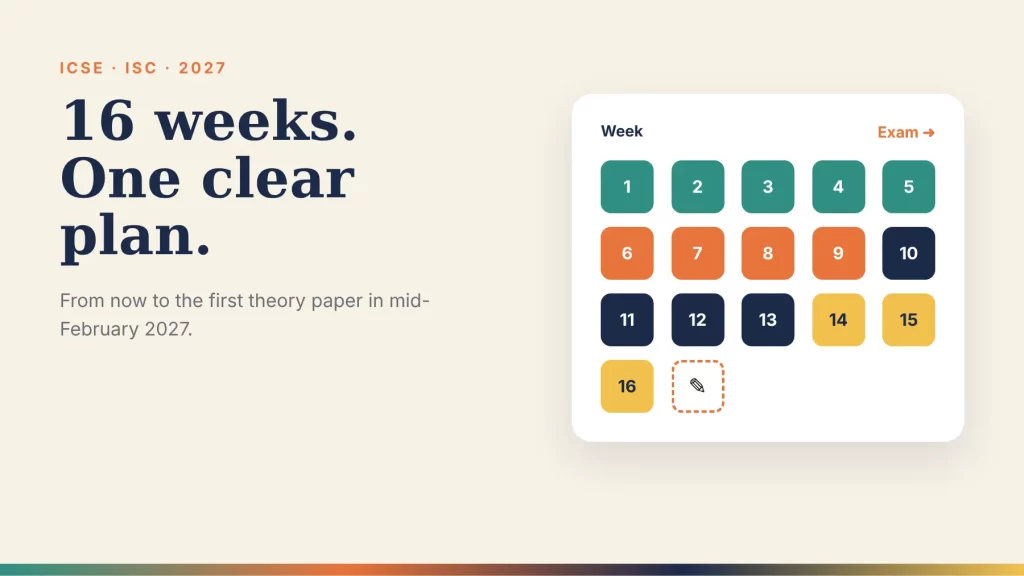
That gives you about 16 weeks from today. Interestingly, the top-performing students aren’t usually the ones who study the longest hours. Instead, they’re the ones who start with a solid plan, before the date sheet pushes them into a last-minute scramble.
What we know so far
| Expected timing | |
| ICSE & ISC date sheet release | November 2026, on cisce.org |
| Practical and project work | January 2027 |
| Theory exams | Mid-February to end of March 2027 |
| Results | April 2027 |
These dates are based on trends from earlier years and news reports in education. CISCE hasn’t confirmed them yet, so it’s wise to keep an eye on the official website at cisce.org for any updates before you make any decisions.
The four-phase plan
Think of the next four months as four distinct phases, each with a clear focus. Knowing what you’re aiming for this month makes it much easier to figure out what to tackle tonight.
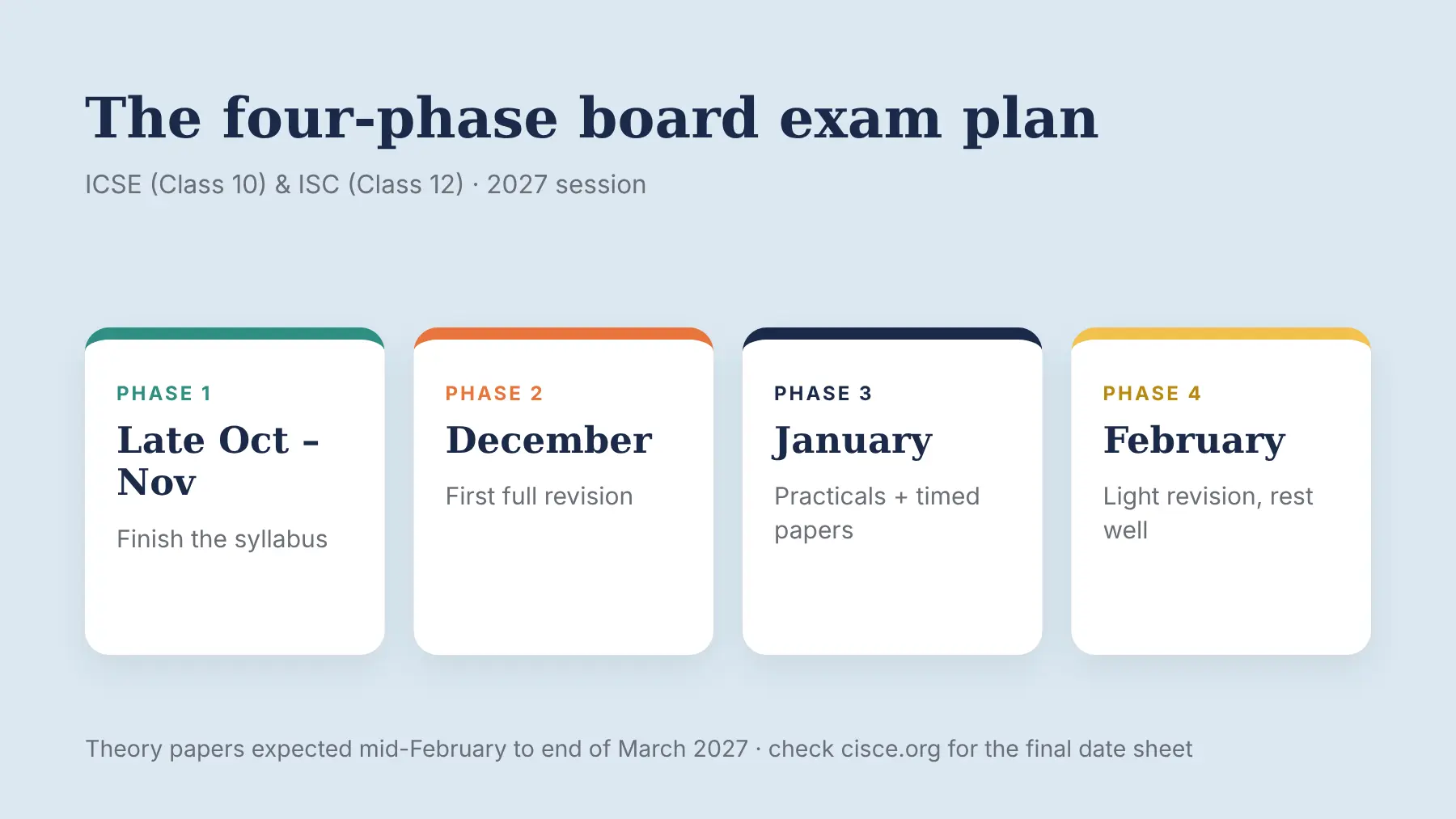
Phase 1: Finish the syllabus (Weeks 1-5, late October to November)
Start by writing down every chapter from every subject. Mark each one with a color code: green for confident, amber for shaky, and red for not done or not understood. Your main goal this month? Change every red chapter to amber or green.
For each chapter, read through it thoroughly. Jot down short notes in your own words, highlighting the key points. Don’t forget to tackle the end-of-chapter questions. Aim for two new topics each day, and spend an extra 30 minutes reviewing what you’ve covered earlier in the week.
Phase 2: Complete first revision (Weeks 6-9, December)
Revise all subjects again but this time with past paper questions chapter by chapter. Our 30-minute chapter revision routine works well here: skim, remember, practice, review.
Start an error log. Buy a notebook and write down every question you missed, why you missed it, and what the correct answer was. Many schools have their prelims around this time. Consider them a rehearsal, not a verdict. Their real value is to tell you what chapters to fix next.
Phase 3: Practicals and Timed Papers (Weeks 10 – 13, January)
Practical exams and project work often happen in January so get your internal assessment work done and submitted early. These are the easiest marks to avoid.
Along with that do at least 2 full papers a week under exam conditions: timed, phone in another room, including reading time. Mark them honestly against the answer key and then see how you are presenting your answers in our guide to write full mark answers in board exams.
Phase 4: Light revision and rest (Weeks 14-16, February)
Nothing new at present. Review your short notes and error log. Keep solving few questions every day. Protect your sleep. But no matter how much you studied, a tired brain remembers less than a rested one.
How to use the date sheet once you have it
1. When CISCE issues the timetable, print it and paste it above your desk. Then do three things.
Count the gap days between every pair of papers.
2. Put your weakest subjects where the gaps are greatest, so you have time for one last revision.
3. Plan each gap day in advance. What will you revise? Which paper will you practice? When will you stop for the nite?
Typical Weekday in Phases 2 and 3
| Time | What to do |
| 6:30–7:15 am | Quick recall of yesterday’s topics |
| School | Pay attention to anything still unfinished |
| 5:00–6:30 pm | Subject 1: practice questions |
| 6:30–7:00 pm | Break: walk, snack, no phone |
| 7:00–8:30 pm | Subject 2: revision and practice |
| 9:00–9:30 pm | Error log and flashcards, then sleep |
Swap one of the study blocks for a full timed paper at the weekend.
Four common mistakes to be avoided
- Instead of practicing, making beautiful notes. Marks are awarded for answering questions. Notes are useful. If you spend more time decorating than solving, re-balance.
- Second language and English ignored. They carry just as much weight on your best of five as Science and Maths, and they reward consistent practice more than a last-minute cramming.
- Leaving project work till last. It always takes longer than you think and eats into time for revision.
- Studying till 2 am. It seems like you accomplish more during late hours but your brain records what you learned while you are sleeping.