Classes 9 and 10 are when the syllabus gets heavier and the board exam starts to feel real. Most students don’t struggle because they study too little. They struggle because they study unevenly: hours on a favourite subject, almost nothing on the one they dread, and no time left to revise. A simple weekly timetable fixes that.
Below is a timetable you can copy, followed by the principles behind it so you can adjust it to your own school hours.
Why a weekly plan works better than a daily one
A daily plan breaks the moment one day goes wrong. A weekly plan gives every subject a fixed number of slots, so a missed session can move to the weekend instead of disappearing. It also lets you see the whole week at once: if Social Science shows up only once, you’ll notice.
The sample timetable
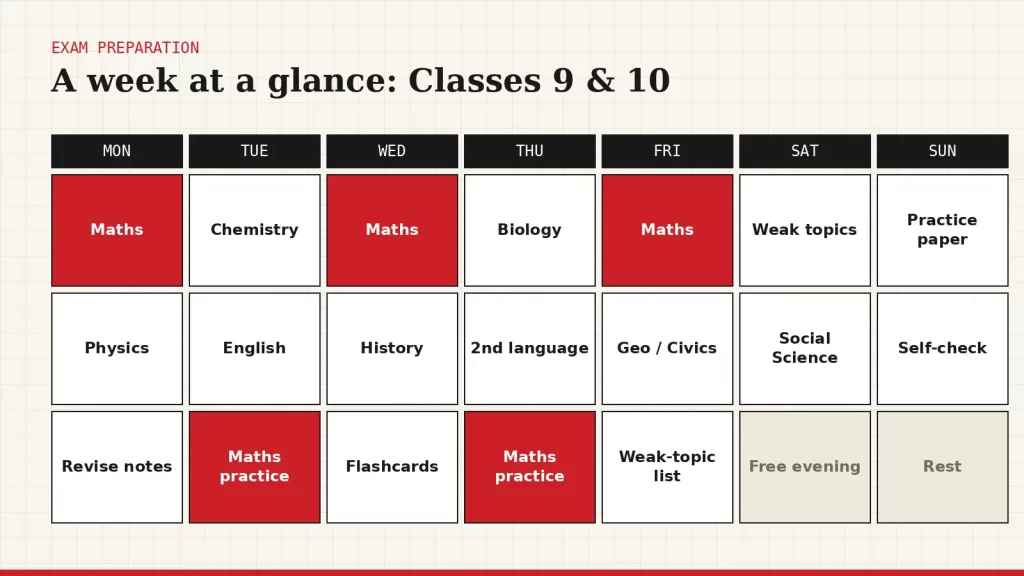
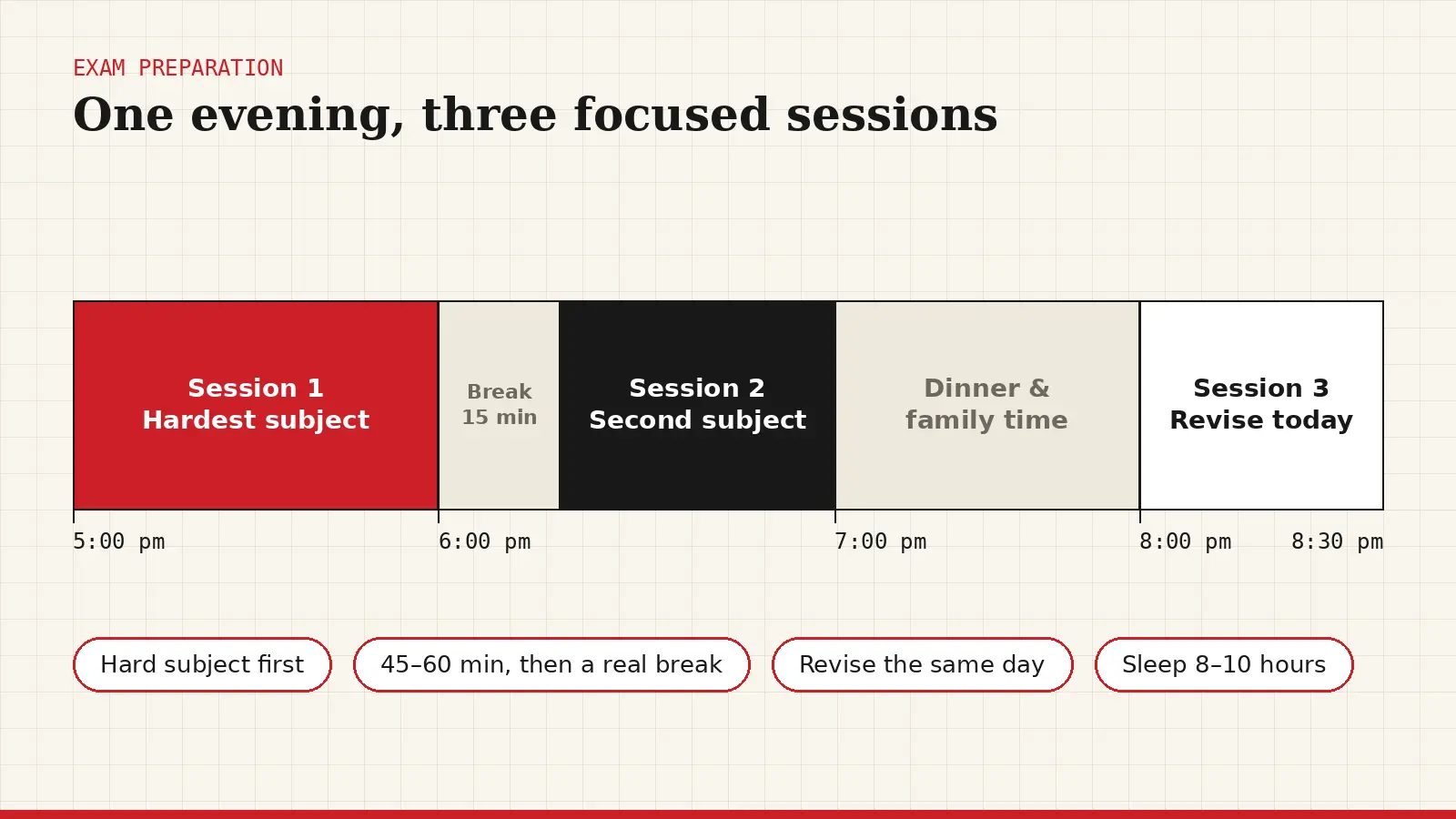
This plan assumes school ends by 3:00 pm. It gives about 2.5 hours of focused study on school days, more on Saturday and a lighter Sunday.
| Day | Session 1 (5:00–6:00 pm) | Session 2 (6:15–7:00 pm) | Session 3 (8:00–8:30 pm) |
| Monday | Maths | Physics | Revise today’s class notes |
| Tuesday | Chemistry | English | Maths practice |
| Wednesday | Maths | History | Formula and vocabulary cards |
| Thursday | Biology | Second language | Maths practice |
| Friday | Maths | Geography, Civics or Economics | List the week’s weak topics |
| Saturday | 9:00–11:00 am: weak topics from Friday’s list | 11:30 am–12:30 pm: Social Science | Evening: free |
| Sunday | 10:00–11:00 am: one timed practice paper | 11:15–11:45 am: check and correct it | Rest of the day: free |
Maths appears most often because it rewards daily practice more than any other subject. If Science or a language is your weak area, give it two of Maths’ slots.
The five rules behind the plan
- Hard subject first. Start each evening with the subject that needs the most concentration, while your mind is fresh.
- Short sessions, real breaks. 45–60 minutes of study, then a 10–15 minute break away from the desk and the phone.
- Revise the same day. A 30-minute look at what was taught in school today saves hours of re-learning later.
- One test every week. A timed paper on Sunday shows what you actually know, not what you think you know.
- Protect sleep and play. Teenagers need 8–10 hours of sleep. Outdoor time and a free Saturday evening are part of the plan, not a reward for finishing it.
How to adjust it
- Tuition or coaching on some days? Count it as Session 1 for that subject and keep Session 3 for revision.
- School ends later? Shift every slot by the same amount; keep the order.
- Exams in two months? Replace Saturday’s weak-topic slot with a second full practice paper.
- Falling behind? Don’t add hours. Use Saturday morning to catch up and keep Sunday as is.
Avoiding burnout
Watch for the warning signs: rereading the same page without taking it in, irritability, or trouble sleeping. When they appear, drop Session 3 for two or three days. A timetable you can keep for months beats a punishing one you abandon in two weeks.
Try this week: print the table, stick it above your desk and tick off each session as you finish it. On Friday, look at what you skipped and move it to Saturday.