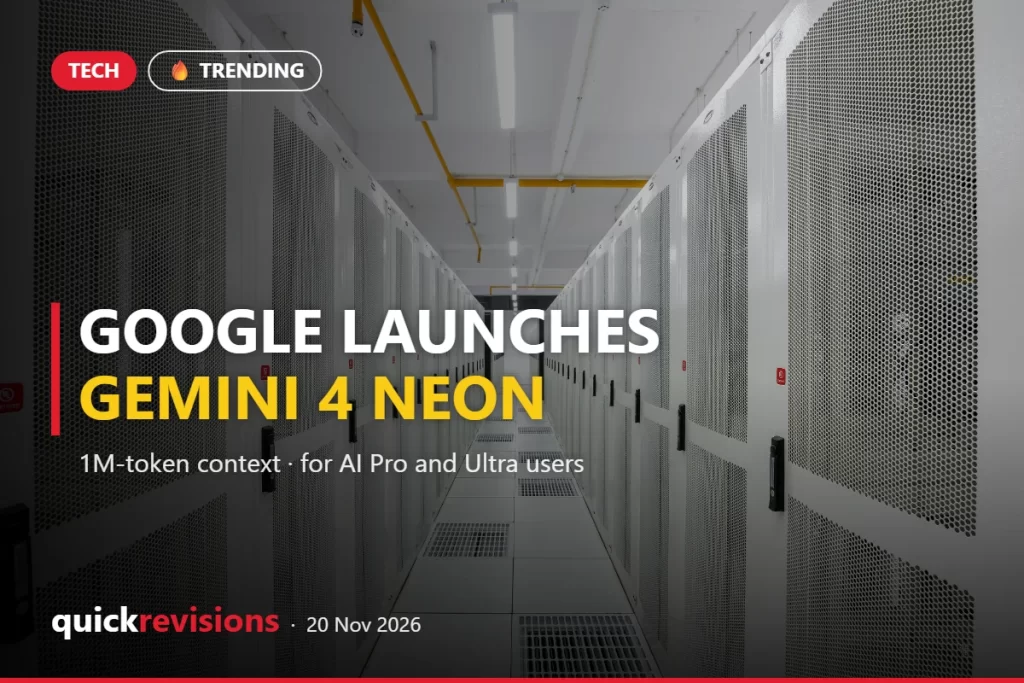
Google has added yet another brain to its AI family, and this one is built to think hard without slowing down. Gemini 4 Neon, launched on 18 November 2026, is a new mid-tier model that Google says delivers close to top-model quality at much faster speed and lower cost. It is live now for Google AI Pro and Ultra subscribers in the Gemini app, and for developers through the Gemini API.
Key Highlights: Gemini 4 Neon at a Glance
- Launch date: 18 November 2026.
- Position: sits between the fast Hydrogen model and the most powerful Carbon model.
- Context window: 1 million tokens, enough for several textbooks at once.
- API price: $3 per million input tokens and $15 per million output tokens.
- Who gets it: Google AI Pro and Ultra subscribers; no free-tier access has been announced so far.
What Is Gemini 4 Neon? Google’s New Middle Model
Think of the Gemini 4 family like a cricket squad, where each player has a role. Hydrogen handles quick everyday tasks, Carbon takes on the hardest, longest projects, and Neon is the all-rounder in the middle, balancing depth and speed. Google calls its intelligence “frontier-level”, and tech site 9to5Google summed it up as Carbon quality at Flash speeds.
Neon is also Google’s fourth Gemini 4 model in under two months. In the Gemini app it replaces the earlier Argon model and appears in the model picker as “Deeper analysis: 4 Neon”.
Gemini 4 Neon Features: What It Can Do
Four Thinking Levels
Users can choose how hard the model “thinks”: Low, Medium, High or Extra High. High is the default. More thinking usually means better answers on tough problems, but slower replies.
Long Documents and Files
With a 1-million-token context window, Neon can read very long PDFs, spreadsheets and photos in a single go. In the Gemini app it can also pull information from Gmail and Google Docs and run multi-step “Tasks”.
Built for Agents and Coding
Google says Neon is strong at long-running “agent” work, where AI carries out a chain of steps on its own, and at following detailed instructions. It claims Neon’s cost per task is 32% lower than Carbon at the default setting.
| Detail | Gemini 4 Neon |
|---|---|
| Launch date | 18 November 2026 |
| Made by | Google DeepMind |
| Context window | 1 million tokens |
| Thinking levels | Low, Medium, High (default), Extra High |
| API price (per million tokens) | $3 input, $15 output, $0.15 cached input |
| Where to use | Gemini app (AI Pro and Ultra), Google AI Studio (paid tier), Android Studio, Google Antigravity, Gemini for business |
| Artificial Analysis Intelligence Index | 61 (Google says #3 overall) |
Did you know? A “token” is a small chunk of text, roughly three-quarters of an English word. So a 1-million-token context window can hold around 7 lakh words in one conversation.
Gemini 4 Neon Price and Availability in India
For everyday users, Neon is part of the paid Google AI Pro and AI Ultra plans in the Gemini app. Google has not mentioned free access in its launch announcement, and no separate India price for Neon has been announced, so it comes with your existing subscription if you have one.
For developers, the API costs $3 per million input tokens and $15 per million output tokens, with cached input at $0.15. Carbon is on an introductory price of $2 and $10 until 30 November; after that its standard rates are $4 and $20, making Neon about 25% cheaper.
Why Gemini 4 Neon Is Trending in India
Gemini is built into Android phones and Google apps that millions of Indians use every day, so each new model sparks a rush of searches like “gemini 4 neon” and “gemini 4 neon vs carbon”. The fast pace of releases, with four Gemini 4 models in under two months, has also left many people wondering which model they should actually pick.
How Students Can Use Gemini 4 Neon Smartly
- Ask for explanations, not answers: “Explain photosynthesis like I’m in Class 8, then quiz me” teaches you far more than copying a reply.
- Make practice questions: upload your chapter notes and ask for 10 MCQs with explanations.
- Always verify: Google itself says Neon can still make mistakes, so check facts against your NCERT textbook or teacher.
- Protect your privacy: never share personal details, passwords or exam papers you are not allowed to share.
What Happens Next for Gemini
Google is retiring the older Gemini 3.1 Pro from the Gemini app, while 3.5 Flash-Lite becomes the “Auto” choice for paid users. Carbon’s introductory pricing ends on 30 November 2026, which may push more developers towards Neon. Members of Google’s Fairwind Program for cyber defenders will get access over the coming days, and a special Neon version for cybersecurity work is planned for trusted defenders.
FAQs About Gemini 4 Neon
When was Gemini 4 Neon launched?
Google launched Gemini 4 Neon on 18 November 2026.
Is Gemini 4 Neon free to use?
Not at launch. It is available to Google AI Pro and Ultra subscribers in the Gemini app and through paid API access; Google has not announced a free tier.
What is the difference between Gemini 4 Neon and Carbon?
Carbon is Google’s most powerful model for the hardest, longest tasks. Neon is faster and cheaper per task while staying close to Carbon in quality, according to Google.
How big is the Gemini 4 Neon context window?
It has a 1-million-token context window, so it can handle very long documents in one conversation.
The Bottom Line
Gemini 4 Neon is Google’s attempt to give people near-top AI quality without the wait or the high bill. For students, the real win is not the benchmark score but how you use it: as a patient tutor that explains, quizzes and helps you revise, while you stay in charge of learning. Pair it with a solid routine like our weekly study timetable for Classes 9 and 10, and if you are preparing for boards, read how the CBSE Class 10 two board exams in 2027 will work.
Check our Trending News section again tomorrow for the next big story, explained simply.
Cover photo: PiDatacenters / Wikimedia Commons, CC BY-SA 4.0 (edited with text overlay)