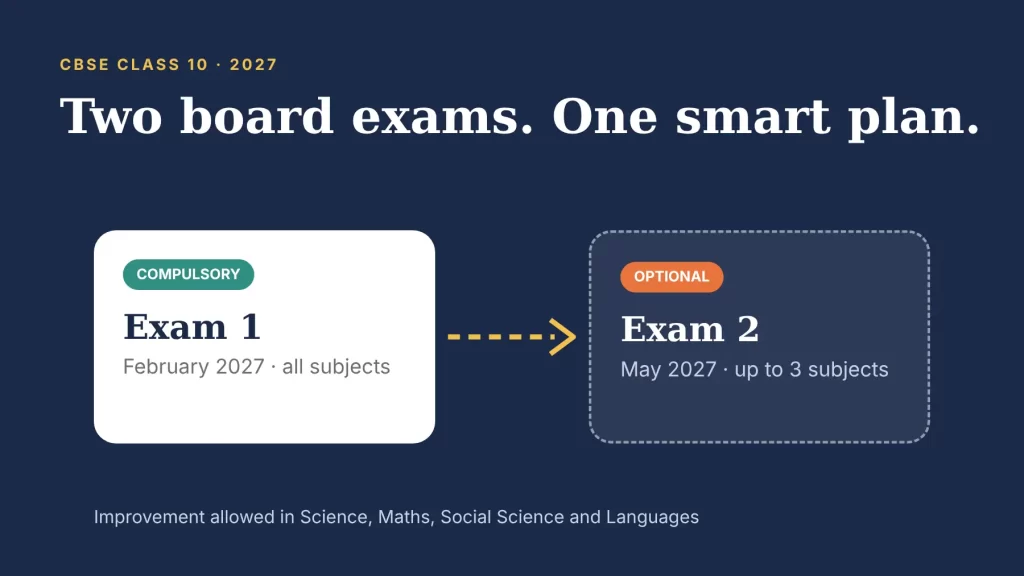
If you are in Class 10 with CBSE this year, you will be the second batch to go through the board’s two-exam system. The first board exam is scheduled for February 2027 and every student must sit it. A second, optional exam is expected from May 2027 for students who want to improve their marks.
A second chance sounds like a safety net, and it is. But students who treat it as a plan B often end up doing worse in both. Here is how the system works, and how to prepare so that you only need one attempt.
How the two exams work
Exam 1 (February 2027) is compulsory. It is treated as the main board exam, and you must appear in all your subjects.
Exam 2 (from May 2027) is optional. It is open to a few groups of students:
- Students who passed and want to improve their marks in up to three subjects from Science, Mathematics, Social Science and Languages.
- Students placed in the Compartment category after the first exam.
- Students who replaced a subject and want to improve their overall result.
Missing three or more subjects in Exam 1 rules you out of Exam 2. CBSE places such students in the “Essential Repeat” category, which means they can only appear in the next year’s main exam in February. This applies whatever the reason for missing the papers.
In 2026, the second exam began on 15 May and results followed by the end of June, so that Class 11 could start in July. Expect a similar timeline in 2027.
Check before you decide: how the marks of the two exams are combined on your final marksheet is set out in CBSE’s circulars. Read the latest one on cbse.gov.in, or ask your school, before you register for the second exam.
Why you should prepare as if there is only one exam
CBSE itself has asked schools to guide students to take the second exam only when they really need to improve, not as a routine attempt. There are good reasons for that:
- There is very little time between the two. Results of the first exam arrive in April, and the second exam begins in May. That is a few weeks to improve, not a fresh start.
- Your stress lasts twice as long. Instead of finishing boards in March, you are still studying in late May.
- Centres are limited. CBSE has said there will be fewer centres for the second exam, so you may be sent to a different centre from your first.
The smartest plan is to aim to be done in February, and keep the May exam for genuine emergencies.
When the second exam does make sense
- You were unwell or had a family emergency during one or two papers.
- One subject went far below your usual level, not just a mark or two.
- You need a higher score in a particular subject for the stream you want in Class 11.
If you would only be chasing one or two extra marks, your May is usually better spent getting a head start on Class 11.
The paper has changed: prepare for these question types
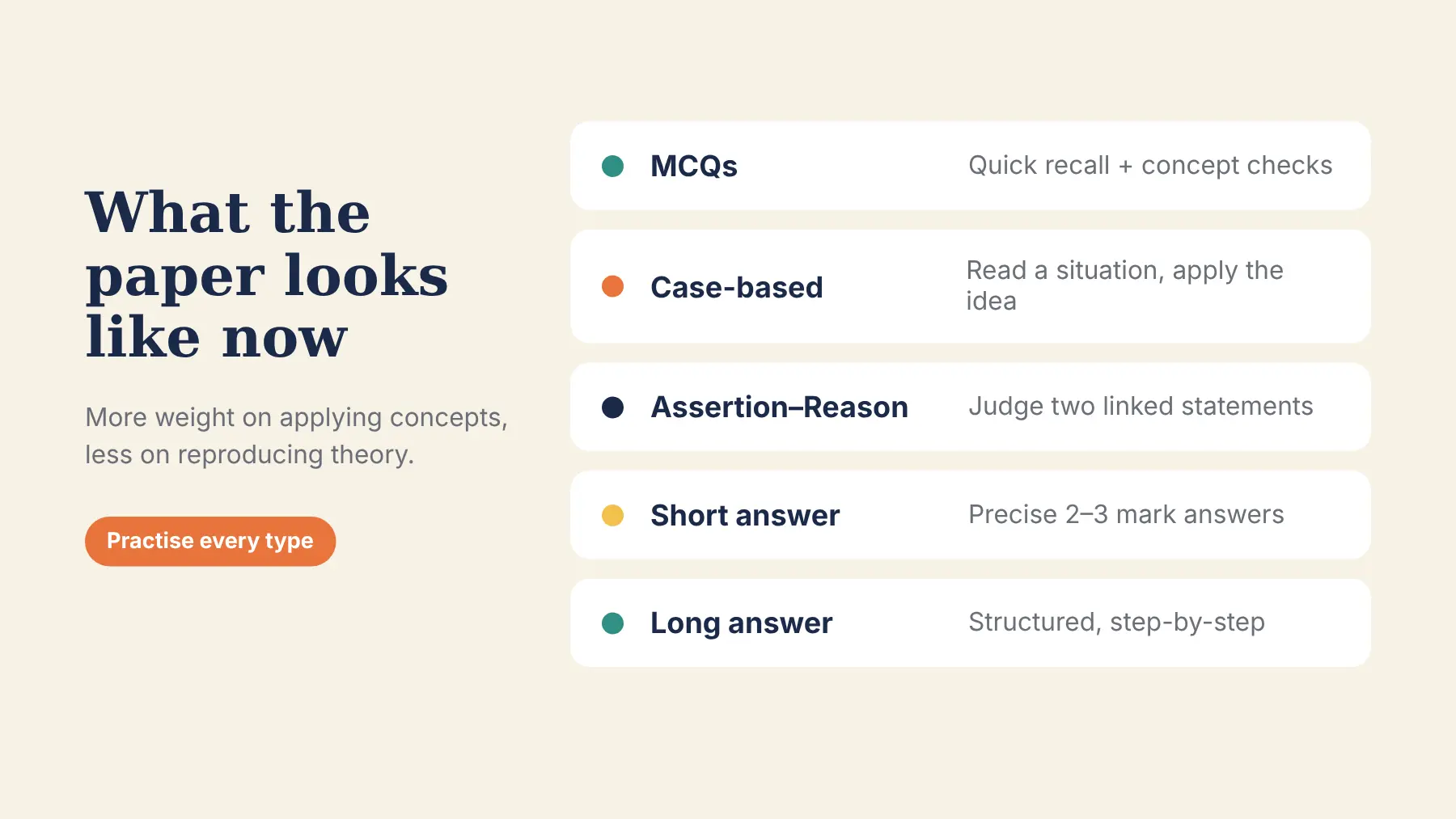
The Class 10 syllabus for 2026–27 gives more weight to application, case-study and situation-based questions than to direct theory. The paper mixes five question types, and each needs its own practice.
Multiple-choice questions. Do 15 to 20 MCQs a day from chapters you have already studied. Speed matters, but so does reading every option before you pick one.
Case-based questions. You get a short passage, a data table or a real-life situation, then questions on it. Read the questions first, then the passage, and underline the facts you need. These questions reward understanding a concept well enough to spot it in a new setting.
Assertion–Reason questions. You judge whether two statements are true and whether the second explains the first. Learn the four standard answer options thoroughly so that you lose no time on the format itself.
Short-answer questions. Two- and three-mark answers are about precision. Use the key terms from your textbook and stop when you have made the required number of points.
Long-answer questions. Plan before you write: an opening line, the main points in order, a diagram or example where it helps, and a short conclusion. Our guide to writing full-mark answers in board exams goes through this step by step.
A simple timeline from now to February
| When | Focus |
| November | Finish the syllabus. Make short notes for every chapter. |
| December | Solve the CBSE sample papers from cbseacademic.nic.in, chapter by chapter, then as full papers. |
| January | Pre-boards. Write at least two timed papers a week and keep an error log. |
| February | Light revision from your notes and error log. Sleep well. |
Do not forget internal assessment. It carries 20 marks in most subjects, and practicals, projects and periodic tests all feed into it. Finish that work on time so it does not compete with revision later.
Keep learning with QuickRevisions
QuickRevisions’s chapter-wise notes and Q&A for CBSE are coming soon. Until then, try our 30-minute chapter revision routine and these note-making habits that help you remember more.
Frequently asked questions
Is the second CBSE Class 10 board exam compulsory?
No. Only the first exam, in February, is compulsory. The second is optional.
How many subjects can I improve in the second exam?
Up to three, from Science, Mathematics, Social Science and Languages.
What happens if I miss the first exam?
If you miss three or more subjects, you cannot take the second exam and will be placed in the Essential Repeat category.
Does Class 12 also have two board exams?
No. The two-exam system currently applies to Class 10 only.