AI chatbots have become part of everyday study life in India. The Bharat Survey for EdTech, released by the Central Square Foundation in 2026 after surveying 12,500 households and 2,500 educators across ten states, found that among school students who use generative AI, 96% use it several times a week and 69% use it every day. OpenAI has also said that India has the largest student population on ChatGPT in the world.
So the real question is no longer whether students should use AI. It is how. Used well, it is a patient tutor available at 11 pm. Used badly, it quietly does the thinking you will need to do alone in the exam hall.
Why the “how” matters for your marks
In a board exam there is no chatbot. You need to recall facts, explain concepts and solve problems on your own, in your own words, under time pressure. That ability is built through effort: trying to remember something, getting it slightly wrong, and correcting it. Learning scientists call this retrieval practice, and it is one of the most reliable ways to make knowledge stick.
When AI hands you a finished answer, you skip exactly that effort. The answer looks right on screen, but very little of it stays in your memory.
Seven ways to use AI that actually help
1. Ask for a simpler explanation, then explain it back. If a textbook paragraph makes no sense, ask for an explanation at your level. Then close the chat and explain the idea out loud or on paper. If you cannot, you have not understood it yet.
Try: “Explain refraction of light to a Class 8 student in five sentences, with one everyday example.”
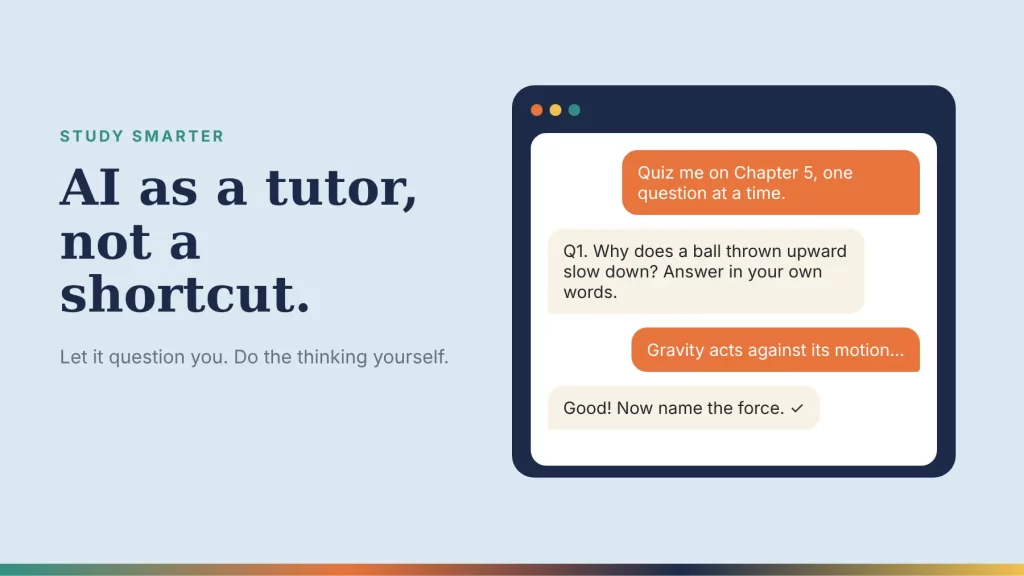
2. Turn it into a quizmaster. This is the single most useful study prompt there is.
Try: “Ask me 10 questions on the chapter ‘Force and Pressure’, one at a time. Wait for my answer before telling me if I’m right.”
3. Get feedback on your own answer. Write your answer first, then paste the question, the marks it carries and your answer, and ask what an examiner would look for that you missed.
4. Find your gaps. Ask it to quiz you with questions designed to reveal what you don’t understand about a topic. Add every weak spot to your revision list.
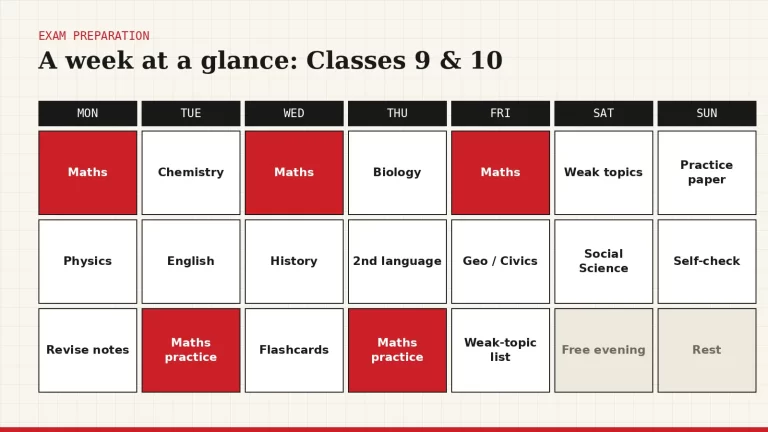
5. Plan your revision. Give it your exam dates, the chapters left in each subject and how many hours you can study each day, and ask for a weekly timetable. Then adjust it to fit your real life.
6. Practise new question types. Ask for case-based or assertion–reason questions on a chapter you have finished, so you are not meeting those formats for the first time in a test.
7. Improve your writing, not replace it. For English and second-language papers, write the essay or letter yourself, then ask for feedback on grammar, structure and vocabulary. Rewrite it using that feedback.
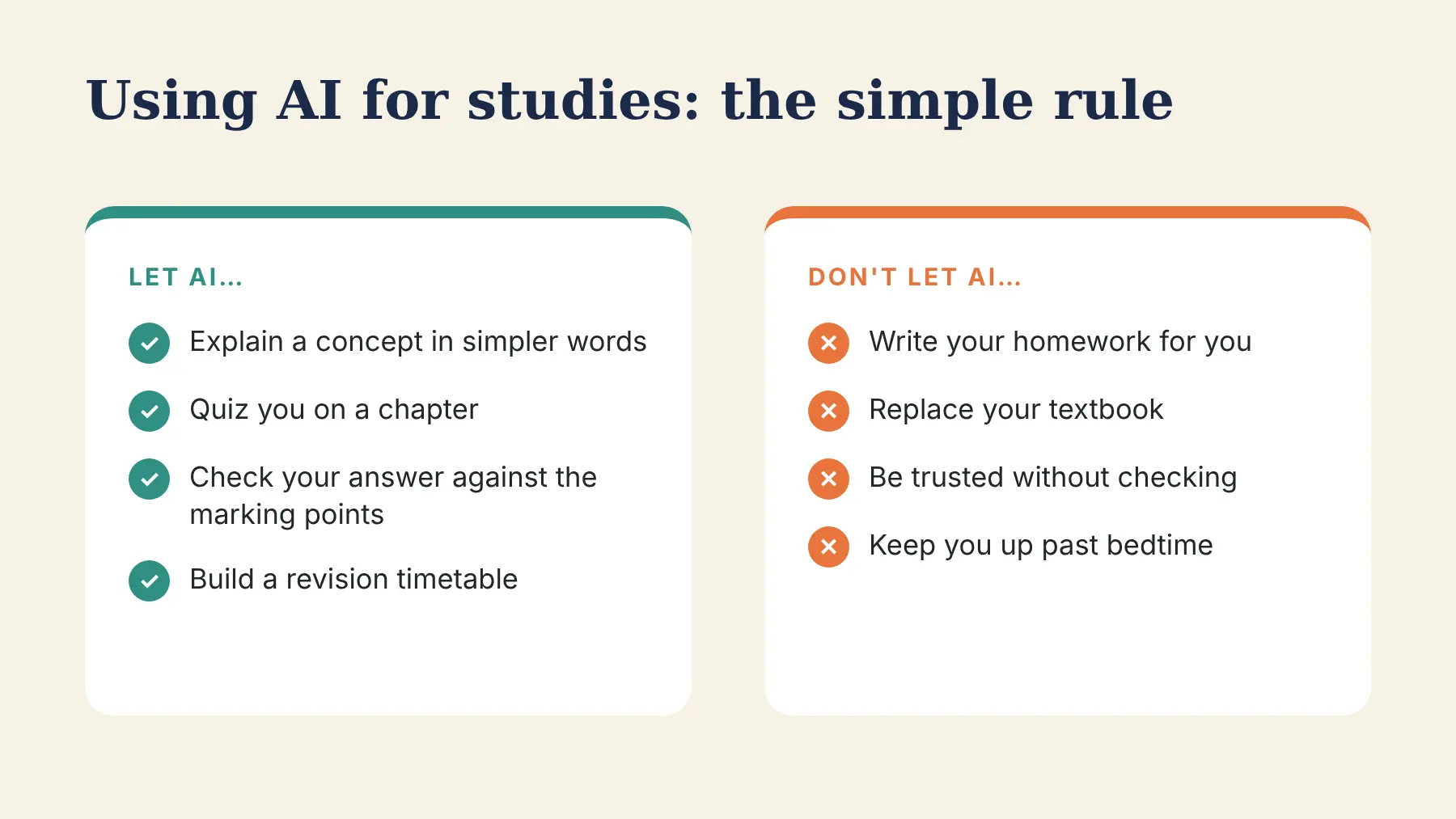
Four habits that quietly hurt your marks
- Copying homework answers. It saves 20 minutes tonight and costs you marks in March. Many schools also treat it as cheating.
- Trusting answers without checking. AI can be confidently wrong. In the Bharat Survey, nearly half of the respondents named wrong information as a major risk of edtech and AI tools. Your textbook and syllabus are what the board marks against, so check definitions, dates and formulas there.
- Chatting instead of studying. A long conversation with a chatbot can feel like work while you learn very little. Set a purpose before you open it, and close it when that purpose is done.
- Late-night screens. Studying on a screen until midnight costs you sleep, and sleep is when your brain stores what you learnt.
One simple rule
Attempt first, AI second, textbook always. Try the question yourself before asking for help. Use AI to explain, quiz and give feedback. Check anything important against your textbook or class notes.
A note for parents
Find out what your child’s school allows. Then, instead of banning AI tools outright, ask your child to explain what they learnt today without the screen in front of them. It is the easiest way to see whether the tool is helping them learn or just helping them finish.
Pair AI with notes you can trust
AI works best when you have a reliable source to check it against. QuickRevisions’s chapter-wise PDFs give you the important points and exam-style questions and answers for each chapter, prepared by teachers and subject experts. Use them as your reference, and use AI to quiz yourself on them. Explore the notes, or read our note-making habits that help you remember more.
Frequently asked questions
Is using AI for homework cheating? It depends on your school’s rules and how you use it. Getting an explanation is usually fine. Submitting work that AI wrote for you generally is not.
Which AI tool is best for studying? Most mainstream chatbots handle explanations and quizzing well. The habits in this guide matter far more than the tool you pick.
Can AI replace my textbook? No. Board exams are marked against your syllabus and textbook, so treat AI as a tutor and your textbook as the final word.