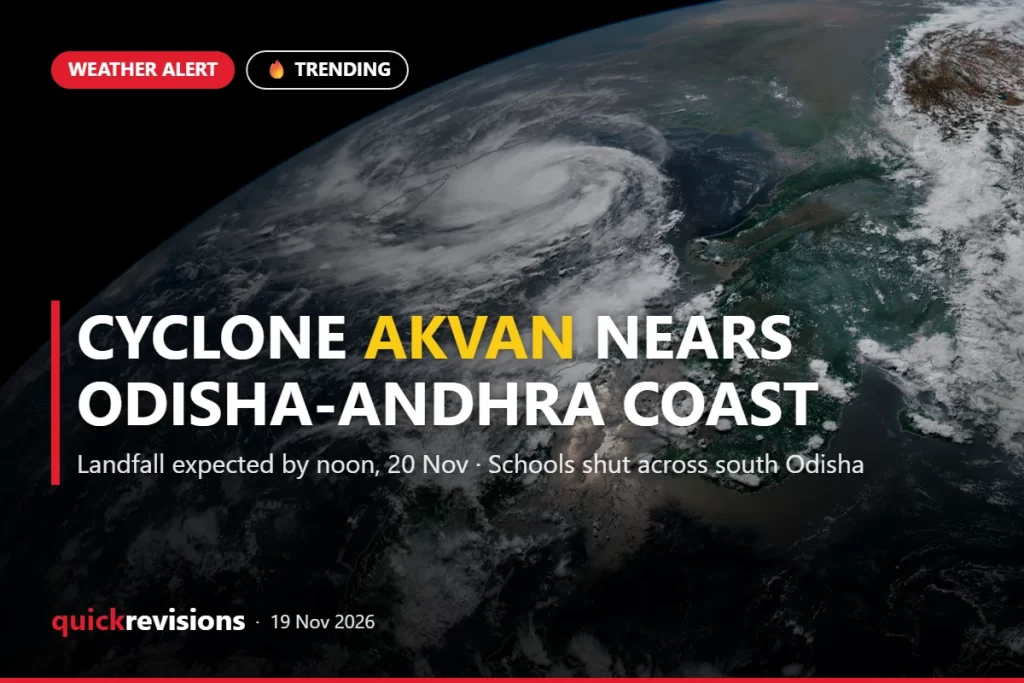
Somewhere over the warm waters of the Bay of Bengal, a spinning mass of cloud is creeping north at walking pace, and it has already shut schools, emptied fishing harbours and moved tens of thousands of people to safety. Cyclone Akvan is expected to cross the coast between Narsapur (Andhra Pradesh) and Puri (Odisha) by about noon on Friday, November 20, bringing gusts of up to 110 km/h and very heavy rain.
That is why “cyclone akvan” and “school holiday today” are among the top searches in India this morning. Here is what we know so far, who is on alert, and how to stay safe.
Cyclone Akvan: Key Highlights
- Where it is: about 480 km south-east of Narsapur and 660 km south of Puri on Thursday morning, moving north at around 5 km/h (IMD).
- Landfall: expected between Narsapur and Puri, across the North Andhra/Yanam and South Odisha coasts, by around noon on November 20.
- Winds: gusts up to 110 km/h are forecast in the alert zones.
- Red alerts on Nov 20: six Odisha districts and six Andhra districts for extremely heavy rain.
- Schools shut: Ganjam, Gajapati, Puri, Jagatsinghpur, Kendrapara and Kandhamal (Nov 19–21), plus Khordha and Malkangiri (Nov 19–20).
- Evacuations: around 50,000 people moved from low-lying areas in Odisha, according to reports.
Cyclone Akvan Landfall: Where and When Will It Hit?
The India Meteorological Department (IMD) expects the storm to move north-north-west and cross the coast by noon on November 20. The window it has given is wide, from Narsapur in Andhra Pradesh up to Puri in Odisha, because forecast models have not fully agreed on the exact track.
In practice, that means the coastal belt from the Godavari delta to southern Odisha should prepare for strong winds, rough seas and flooding rain on Thursday night and Friday. Rain bands usually arrive many hours before the eye itself, so conditions can turn dangerous well before landfall.
How strong will the winds be?
IMD has warned of gusts reaching about 110 km/h in the alert zones. That is strong enough to bring down weak trees, power lines and tin roofs, which is why authorities are asking people to stay indoors once the rain intensifies.
Red and Orange Alerts: Districts to Watch
| State | Red alert (Nov 20) | Orange alert (Nov 20) |
|---|---|---|
| Odisha | Kandhamal, Gajapati, Ganjam, Puri, Jagatsinghpur, Kendrapara | Malkangiri, Balangir, Rayagada, Koraput, Kalahandi, Subarnapur, Boudh, Nayagarh, Khordha, Cuttack, Mayurbhanj, Balasore |
| Andhra Pradesh | Srikakulam, Vizianagaram, Anakapalli, Visakhapatnam, Kakinada, Alluri Sitharama Raju | East Godavari, Konaseema, West Godavari, Parvathipuram Manyam |
| Other states | Tamil Nadu also under heavy-rain alerts | Rain also likely in Chhattisgarh, Telangana and West Bengal |
Alerts are updated several times a day, so always check the latest IMD bulletin or your district administration before travelling.
School Holiday Today: Which Schools Are Closed?
Odisha has ordered schools shut as a precaution. All government, aided and private schools in Ganjam, Gajapati, Puri, Jagatsinghpur, Kendrapara and Kandhamal are closed from November 19 to 21. Schools in Khordha and Malkangiri are closed on November 19 and 20. District collectors can extend these closures if conditions worsen.
Outside the cyclone zone, there is no general closure. Schools in Delhi-NCR, Uttar Pradesh, Bihar, Jharkhand, Rajasthan, West Bengal and Tamil Nadu were reported open on Thursday, though individual schools can issue their own notices. Students should watch for messages from their school rather than rely on social media forwards.
Did you know? The name “Akvan” was proposed by Iran. It comes from Persian mythology, where Akvan is a demon (div) in Ferdowsi’s epic Shahnameh who battles the hero Rostam. Cyclones in the North Indian Ocean are named from a list of 169 names contributed by 13 countries, including India, and adopted in 2020.
Why Cyclone Akvan Is Trending in India
Three things have pushed the storm to the top of Google Trends. First, families across Odisha and Andhra Pradesh want to know if schools are open. Second, people in Kolkata and West Bengal are searching for weather updates, since the outer rain bands may reach them. Third, late-season cyclones are rarer and grab attention: the Bay of Bengal has a second cyclone season from October to December, after the monsoon withdraws.
What Happens Next and How to Stay Safe
The next 36 hours matter most. After landfall, cyclones usually weaken quickly over land, but the rain can continue for a day or two and cause flooding inland.
- Keep phones and power banks charged and save local helpline numbers.
- Store drinking water, dry food, a torch and basic medicines.
- Stay away from the sea, rivers and fallen power lines.
- Fishermen should not venture out until the warning is lifted.
- Follow IMD, the Odisha State Disaster Management Authority and your district collector for official updates.
FAQs on Cyclone Akvan
When will Cyclone Akvan make landfall?
IMD expects it to cross the coast between Narsapur and Puri by around noon on Friday, November 20, 2026. Timing can shift slightly as the storm moves.
Is there a school holiday today in Odisha?
Yes, in several districts. Ganjam, Gajapati, Puri, Jagatsinghpur, Kendrapara and Kandhamal schools are shut from Nov 19 to 21, and Khordha and Malkangiri schools on Nov 19–20.
Will Cyclone Akvan affect Kolkata?
Kolkata is far from the expected landfall zone, but rain is forecast for parts of West Bengal. Check the IMD Kolkata bulletin for local updates.
Which country named Cyclone Akvan?
Iran suggested the name. It is taken from a figure in Persian mythology.
The Bottom Line
Cyclone Akvan is a reminder of how much careful planning, from early warnings to school closures, now protects lives on India’s east coast. Stay indoors when the storm arrives, trust official sources, and check on elderly neighbours. Students revising this topic can learn how such events are managed in our notes on natural and man-made disasters.
We will keep tracking the biggest stories in India. Visit our Trending News section again tomorrow for the next update.
Cover photo: NOAA / Wikimedia Commons, Public domain (edited with text overlay)